
PaleoTech is a physics-driven, data-backed, multi-layer intelligence platform that turns planetary signals into climate and agricultural decisions. It does this by unifying 4 tightly integrated layers — from deep-Earth physics to farm-scale outcomes — into a single coherent system designed for accuracy, early detection, and real-world usability.
Where conventional systems begin with weather models, PaleoTech begins at the source of climate itself: Earth’s tilt, rotation, and energy flows. From this foundation, the platform builds upward through climate interpretation, agricultural planning, hazard detection, and an adaptive AI backbone that evolves continuously.
The PaleoTech Platform Flow Diagram
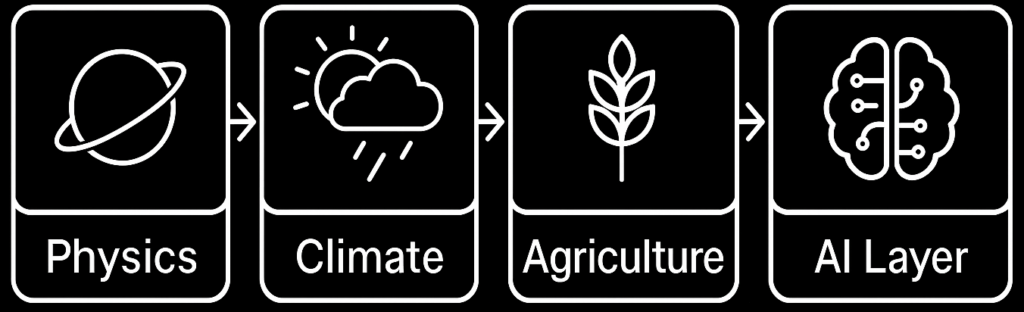
1. Core Physics Engines
The Core Physics Layer is the deepest tier of PaleoTech. It captures Earth’s fundamental motions, energy flows, and momentum transfers — forming the base signals that power all downstream climate, hazard, and agriculture modules.
 PaleoIQ — Climate-State Engine (Primary Core)
The foundational physics-driven engine that reconstructs and interprets large-scale climate behaviour using axial tilt, ENSO dynamics, orbital mechanics, mass flow and long-lead system signals. Everything in PaleoTech either feeds into PaleoIQ™ or is powered by it.
 AxisPulse — Axial Tilt & Wobble Monitoring
Real-time tilt, wobble, polar motion, and obliquity-energy signatures.
 MassFlow — Planetary mass & circulation dynamics
Atmospheric and oceanic mass flow, angular momentum, circulation, and global momentum anomalies.
 AtmosWATCH — Atmospheric Moisture & Hydrological Behaviour Engine
AtmoSPHERE™ analyses atmospheric moisture drivers, circulation context, climate-state signals, land–surface properties, and hydrological behaviour to estimate soil and surface moisture conditions across paddocks, subregions, and regions.
 OceanWATCH — Ocean Boundary State & Circulation Context Engine
OceanWatch™ analyses large-scale ocean boundary conditions and circulation signals — including basin-scale temperature structure, current systems, overturning circulation indicators, and ocean–atmosphere coupling metrics — to characterise background oceanic constraints and drivers relevant to regional and global climate behaviour.
2. Climate Engines
The Climate Layer translates PaleoTech’s physics signals (tilt, rotation, mass flow) into actionable climate-state intelligence: ENSO regimes, rainfall phases, atmospheric behaviour, ocean conditions, and seasonal windows. These engines form the middle tier of PaleoTech — between physics and agriculture.
 ESNOLink — ENSO Regime Detection & Forecasting
Models ENSO behaviour using physical signals, tilt anomalies, wind-state patterns, and Pacific-state dynamics.
STRLink — Subtropical Ridge Regime
Models the Subtropical Ridge behaviour using physical signals, ocean, wind-state patterns, and Pacific-state dynamics.
 WindMAP — Atmospheric flow-state detection
Jet-stream behaviour, regional flow structures, and atmospheric momentum interactions that influence rainfall patterns, ENSO development, and volatility.
 RainMAP — Rainfall Reconstruction & Hydrological Coherence
Reconstructs rainfall behaviour, seasonal deviations, hydrological risk windows, and regional signatures.
 TempMAP — Temperature outlook engine
Provides temperature reconstructions and forward outlooks built from PaleoTech’s underlying climate-state signals.
3. Agricultural Engines
The Agriculture Layer transforms climate-signal intelligence into seasonal planning, risk windows, paddock-level behaviour, and farm-ready outputs. These engines sit directly above Climate Engines and are the outward-facing intelligence used by farmers, agronomists, and demonstration farms.
 SoilSYNC — Soil–Climate Synchronisation & Field-State Intelligence
Connects soil-condition indicators with climate-state signals to produce interpretable insights on field readiness, planting windows, operational constraints, and sub-surface behaviour.

 CropCAST — Seasonal Climate Intelligence for Agriculture
Our Flagship Farm-ready companion with capital management, rainfall outlooks, climate windows, volatility profiles, ENSO phase assessments, and operational guidance for agronomy.
4. AI & Signal Engines
The AI & Signal Layer unifies all physics-driven signals across PaleoTech into a single adaptive intelligence framework. It performs real-time regime detection, anomaly scoring, seasonal signal alignment, system-state interpretation, and forecast optimisation. This is the core analytical brain of the platform
 PaleoAI — AI-Driven Intelligence Layer
 SignalEngine — Adaptive AI Signal Layer
 PatternEngine — Analogue Discovery Engine
 ForecastEngine — Seasonal Outlook Optimisation Layer